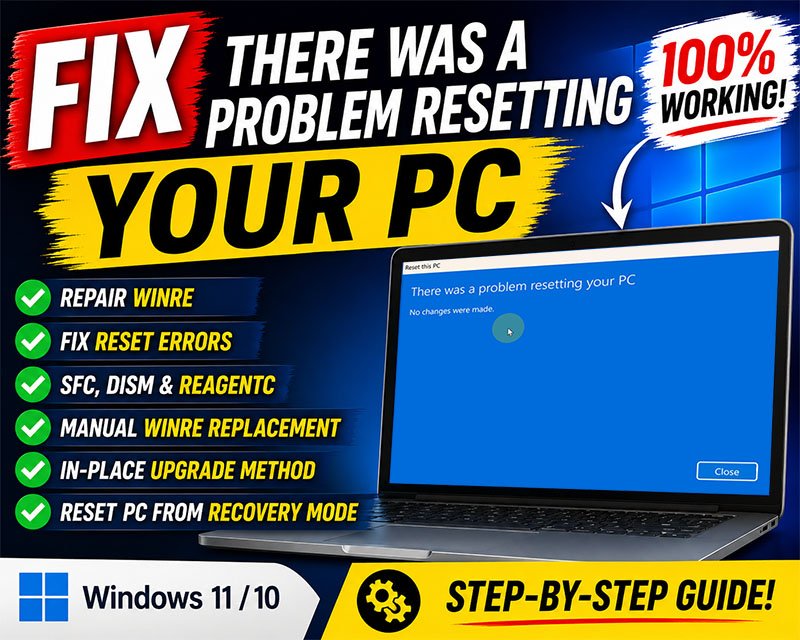
If “Reset this PC” keeps failing in Windows 10 or Windows 11 with the message “There was a problem resetting your PC”, this guide will help you fix it for good. The most common culprit is a broken, mismatched, or disabled Windows Recovery Environment (WinRE), but damaged system files, antivirus conflicts, or a too‑small Recovery partition can also cause failures.
Below, you’ll find the exact steps shown in the video, expanded with additional proven solutions, safety notes, and commands you can copy/paste.
Video Guide
Prefer to watch first? Follow along with our tutorial, then use the written steps below for deeper detail and easy copy/paste commands.
Before You Start
- Back up important files (an external drive or cloud is best).
- Plug in your PC and sign in as an administrator.
- If BitLocker is enabled, keep your recovery key handy.
- Free up 15–25 GB if possible (for reset or in‑place upgrade).
- Temporarily disable third‑party antivirus or security tools.
Why This Error Happens
- WinRE (Windows Recovery Environment) is missing, corrupted, disabled, or version‑mismatched with your current Windows build.
- Damaged system files (SFC/DISM repairs needed).
- Malware or antivirus interference blocking the reset.
- Recovery partition is too small or misconfigured.
- Broken Windows Update components.
Step 1: Check WinRE Status and Version
- Open Command Prompt as admin:
- Start > type CMD into search box> right‑click Command Prompt > Run as administrator.
- Check WinRE status:
reagentc /info- Note whether Windows RE status is Enabled and copy the Windows RE location (for example:
\\?\GLOBALROOT\device\harddisk0\partition4\Recovery\WindowsRE).
- Note whether Windows RE status is Enabled and copy the Windows RE location (for example:
- Check your Windows build:
- Press Windows + R, type
WinVer, press Enter (note version/build).
- Press Windows + R, type
- (Optional) Check installed language:
dism /online /get-intl
- (Optional) Check the exact WinRE image build (replace the path with yours from
reagentc /info):dism /get-imageinfo /index:1 /imagefile:\\?\GLOBALROOT\device\harddisk0\partition4\Recovery\WindowsRE\winre.wim
Interpret the results:
- If WinRE build matches your Windows build → Go to Solution 1.
- If WinRE build mismatches or WinRE is missing → Go to Solution 2.
Solution 1: When WinRE Build Matches: Re‑enable WinRE and Repair System Files
- Toggle WinRE off/on:
reagentc /disablereagentc /enable
- Repair system files using SFC and DISM:
sfc /scannowdism /online /cleanup-image /restorehealth
- (Optional) Component store cleanup:
dism /online /cleanup-image /startcomponentcleanup
- Try Reset this PC again:
- Windows 11: Settings > System > Recovery > Reset this PC
- Windows 10: Settings > Update & Security > Recovery > Reset this PC
Solution 2: When WinRE Build Mismatches: Update or Replace WinRE
Option 1: Update Windows (fastest if Windows Update works)
- Windows 11: Settings > Windows Update > Check for updates
- Windows 10: Settings > Update & Security > Windows Update > Check for updates
Reboot and try Reset this PC again. If updates fail or you’re already current, use Option 2 or 3.
Option 2: Perform an In‑Place Upgrade (repairs WinRE automatically)
- Download the official ISO with identical language to your default or display language:
- Windows 11: microsoft.com/software-download/windows11
- Windows 10: microsoft.com/software-download/windows10
- Right‑click the ISO > Mount, then run setup.exe.
- Click Next > Accept. When prompted, choose to Keep personal files and apps (if available).
- Important Note: If the ISO language doesn’t match your display language, “keep apps” may be unavailable.
- Choose the best option for your situation.
- After installation completes, try Reset this PC again.
Option 3: Manually Replace the WinRE File (advanced, precise)
You’ll extract a fresh winre.wim from a Windows ISO that matches your system build and language.
Safety note: Use DiskPart with care. Selecting the wrong disk/partition can cause data loss. Back up first.
- Identify build and language:
- Press Windows + R >
winver(note version/build). - Run:
dism /online /get-intl
- Press Windows + R >
- Get a matching ISO:
- Latest releases: download from Microsoft (links above).
- Specific older builds: search your exact build + language +
site:archive.org.- Verify source and checksums where possible.
- Disable WinRE and review status:
reagentc /inforeagentc /disable
- Check if
winre.wimexists on C:Dir /a /s c:\winre.wim- If exists:
- Remove system and hidden attributes from WinRE.wim file:
attrib -h -s C:\Windows\System32\Recovery\winre.wim
- Back it up:
ren C:\Windows\System32\Recovery\winre.wim winre.wim.bak
- Remove system and hidden attributes from WinRE.wim file:
- If not exist in C partition: it’s likely in the hidden Recovery partition.
- Check for
winre.wimon Recovery Partition:- Open Diskpart:
diskpart
- Select the disk and recovery partition using their numbers you saw
in "reagentc /info". Example, if you saw “\GLOBALROOT\device\harddisk0\partition4\Recovery\WindowsRE“, then use:sel dis 0sel par 4
- Assign a letter to the Recovery partition (if needed):
assign letter=R
- Close Diskpart:
exit
- Remove system and hidden attributes from WinRE.wim file:
attrib -h -s R:\Recovery\WindowsRE\winre.wim
- Move WinRE.wim file to windows partition with a new backup name:
move R:\Recovery\WindowsRE\winre.wim C:\Windows\System32\Recovery\winre.wim.old
- Open Diskpart:
- Mount the ISO file.
- Extract a fresh
winre.wimusing one of the methods below.
Method A: Use DISM (built-in)
- List indexes in the ISO image:
dism /get-wiminfo /wimfile:E:\sources\install.wim- If it’s
install.esd, use:/wimfile:E:\sources\install.esd.
- If it’s
- Create a mount folder and mount the correct index (start with index 1 or the edition you use):
mkdir C:\MountISO dism /mount-image /imagefile:E:\sources\install.wim /index:1 /mountdir:C:\MountISO
- Copy the new WinRE file:
copy C:\MountISO\Windows\System32\Recovery\winre.wim C:\Windows\System32\Recovery\winre.wim
- Unmount:
dism /unmount-image /mountdir:C:\MountISO /discard rmdir C:\MountISO
- Finalize and re-enable WinRE:
reagentc /enablereagentc /info
- If the reagentc /enable failed to enable recovery, read this topic or this topic to learn how to fix that.
Method B: Use the Recovery Repair Script
- Download the ValiumMedia Tech Recovery Repair script V1 from this link, or V2 from this link (recommended).
- Right‑click the ISO > Mount.
- Right‑click the script > Run with PowerShell, then follow the prompts.
- If prompted, allow it to install 7‑Zip (press Y when asked).
- If the Recovery partition is too small, the script will offer to expand it. Follow the on‑screen instructions.
- The script will extract the suitable WinRE file and then enables the Recovery automatically.
Now try Reset this PC again from Recovery Settings or from Advanced startup (below).
Solution 3: Reset the PC from Windows Recovery (Advanced Startup)
If malware, drivers, or running services are blocking the reset within running Windows, perform it from the Windows Recovery Environment instead.
- Open Advanced startup:
- Windows 11: Settings > System > Recovery > Advanced startup > Restart now
- Windows 10: Settings > Update & Security > Recovery > Advanced startup > Restart now
- Or hold Shift and click Restart from the Start menu or sign‑in screen.
- In the blue menu:
- Troubleshoot > Reset this PC.
- Choose:
- Keep my files (removes apps/settings, keeps personal files).
- Remove everything (full factory reset; use “Fully clean the drive” if you’re selling the PC).
- Choose:
- Cloud download (fresh files from Microsoft; needs ~4–6 GB and stable internet; best if system files are corrupt).
- Local reinstall (uses local recovery files; faster, works offline).
- Click Reset and let the process complete (several restarts are normal).
What If the Recovery Partition Is Too Small?
Recent Windows builds often need a 750 MB–1 GB Recovery (WinRE) partition. If you see space errors:
- Recommended: Let the Recovery Repair script resize the partition automatically (Method: B above).
- Advanced manual (GPT example):
- Shrink the OS partition slightly, extend or recreate the Recovery partition to at least 1 GB, set the Recovery partition type GUID
de94bba4-06d1-4d40-a16a-bfd50179d6acwith attributes0x8000000000000001, then:reagentc /setreimage /path R:\Recovery\WindowsRE reagentc /enable - Only do this if you’re comfortable with DiskPart and have a verified backup.
- Shrink the OS partition slightly, extend or recreate the Recovery partition to at least 1 GB, set the Recovery partition type GUID
Extra Fixes That Often Help
- Clean boot before retrying reset:
- Run
msconfig> Services tab > check Hide all Microsoft services > Disable all. - Open Task Manager > Startup tab > Disable all non‑Microsoft items.
- Reboot and try Reset this PC.
- Run
- Uninstall third‑party antivirus/security suites completely (reinstall later).
- Malware scan:
- Windows Security > Virus & threat protection > Scan options > Microsoft Defender Offline scan.
- Check disk health:
chkdsk C: /scan- If errors are found:
chkdsk C: /f- (You’ll be prompted to schedule on next reboot.)
- If errors are found:
- Repair Windows Update components (if updates fail):
net stop wuauserv net stop bitsnet stop cryptsvcren C:\Windows\SoftwareDistribution SoftwareDistribution.oldren C:\Windows\System32\catroot2 catroot2.oldnet start cryptsvcnet start bitsnet start wuauserv
- Enable/point WinRE if you see “Could not find the recovery environment”:
reagentc /setreimage /path C:\Windows\System32\Recoveryreagentc /enablereagentc /info
- Command‑line reset (sometimes works when Settings fails):
systemreset -factoryreset
- System Restore (if available):
- Advanced startup > Troubleshoot > Advanced options > System Restore.
- Startup Repair:
- Advanced startup > Troubleshoot > Advanced options > Startup Repair.
- Last resort:
- Create a bootable USB with Rufus tool or in your mobile and perform a clean install (back up data first).
Frequently Asked Questions
Cloud download vs Local reinstall — which should I choose?
Cloud download pulls fresh files from Microsoft and is best when local recovery files are corrupt. It requires a stable connection and several GB of data. Local reinstall is faster and works offline but uses existing recovery files.
Will I lose my files?
Keep my files preserves personal files but removes apps and settings. Remove everything wipes all files and apps. Always back up your data first.
Why can’t I keep my apps during an in‑place upgrade?
The ISO’s language and edition must match your installed Windows. If they don’t, the “Keep personal files and apps” option may be unavailable.
Do I need my BitLocker key?
Potentially. Some operations (partition changes, startup repairs) can trigger BitLocker. Keep your recovery key ready.
Recap: What Usually Fixes It
- Quick wins:
reagentc /disablethenreagentc /enable, followed bysfc /scannowanddism /restorehealth. - If WinRE mismatches: update Windows or run an in‑place upgrade.
- Still stuck: manually replace
winre.wimfrom a matching ISO, or reset from Advanced startup with Cloud download. - As a last step: back up and do a clean install from a USB.
Notes
If the Recovery Repair script offers to install 7‑Zip or resize your Recovery partition, follow the prompts. Always keep backups before making partition changes.
Questions or success stories? Drop a comment below and let us know what worked for you.


